
What Comics Can Teach Us About Making Science Videos

Huh? Comics? Are you serious? You probably think I’ve taken leave of my senses….but bear with me.

One of my favorite non-fiction books is Understanding Comics: The Invisible Art by Scott McCloud. Despite its age (published in 1993), this book is one of the most creative and entertaining books I’ve ever read about visual storytelling. In this book, McCloud covers the history and theory of comics, using the comic book format brilliantly to make his points about this under-appreciated art form.

And did I mention that I don’t even particularly like comics? That should tell you just how great this book is.

I happened to see a reference to it somewhere (many years ago) and was intrigued by comments about how deeply the book explored the form and substance of storytelling as well as the history of “sequential art”. I ran right out to the nearest bookstore and bought it. I was not disappointed. I’ve reread it several times over the past twenty years or so and often recommend it to people.

Forget whatever you think you know about comics. Anyone who engages in any type of visual storytelling can learn something from this book…and be entertained at the same time.  Even though it was first published twenty years ago, the content is timeless and perhaps even more relevant now, in the digital information age. Despite its topic and engaging delivery, Understanding Comics is a serious book. At its core, this book is about creativity. The information McCloud presents goes far beyond comics and can be applied to virtually any creative process, even those not involving visual formats.

The idea to use the comic format to write a book about the comic art form was clever and, moreover, was executed flawlessly. McCloud appears in the book in the form of a cartoon image with an engaging “voice”, which we (the readers) immediately accept as our guide through the world of comic art. We very quickly realize, after the first page or so, that the view of comics as simple-minded cartoons is based on very superficial features and not reflective of the artistic and intellectual processes underpinning the medium. As any writer or artist knows, creating something that tells a complex story but appears to be simple is very, very difficult. McCloud dissects the process of stripping things to their basic elements and reassembling them to tell a compelling story through the medium of “sequential art”. He articulates several theories and develops models about visual storytelling, such as the concept of  “closure” and the six steps that comic book artists (and other artists) take in going from an idea to the final product.

If you care even a little about how the creative process works, you’ll like this book (and if you like comics, you’ll love it). For those of us interested in making science videos, however, books such as this reveal a lot about how we see things and how to convey abstract ideas so that others can also see them. Learning how to turn the abstract science concept into something concrete (and at the same time be entertaining or compelling) is one of our biggest stumbling blocks in creating effective science videos. Scientists also have particular difficulty in turning what they want to say into something a viewer wants to hear (and see). Understanding Comics provides a peek into another storytelling medium that can show us how we might overcome these barriers….or at least inspire us to try.
Can You Describe a Scientific Method in a One Minute Video?

I’ve been discussing the pros and cons of short science videos and how length influences viewer engagement (see previous post). In general, the shorter the video, the more likely the average viewer is to watch it through to the end. However, a colleague questioned whether it was possible to adequately describe a scientific method in only a minute. My response was that it was possible, although not necessarily easy. And, obviously, not all methods could be described in such a short time period.

Although it’s good to strive for brevity, your video, especially if for instructional purposes, should be of a length appropriate to the purpose and for the target audience.

So I thought I would critique a couple of videos describing a scientific technique and see how successful they were. The first one, done by the Texas Parks and Wildlife, shows how to use the Daubenmire frame, a widely-used method for surveying vegetation. I selected it because it happens to be about a minute in length, it has a clear purpose, and the method is one that most people, including non-scientists, can comprehend and replicate with inexpensive supplies. Take a look and then we’ll consider how successful it was.

I thought this video was well planned, nicely executed, and accomplished its purpose of explaining what a Daubenmire frame is and how to use one to gather data about the vegetational composition in an area. The video begins with a short, simple explanation of the purpose of the Daubenmire frame and then moves into explaining how to construct the frame (briefly) and how to select sampling sites. It briefly describes how to position the frame and what data might be collected (numbers of each species present or their percent cover).

Note how the video minimizes the “talking head” shots and uses cutaways to show what the narrator is talking about. Also, there is a variety of footage shot from different angles, which were clearly planned in advance. The video opens and ends with the narrator talking to the camera, which nicely “book-ends” the instruction.

The video does not get bogged down in explaining how to get a “random sample”, how to identify plants, or how to estimate percent cover. It assumes that the target audience already understands these concepts or will get that information somewhere else. One thing that could have been explained in one sentence is why it’s called a Daubenmire frame (named after a plant ecologist who developed the canopy-coverage method of vegetation analysis). This fact is not essential to the instruction but would have answered an obvious question and added a bit of history to the video.

The audio is clear and without distracting background noises. It looks like the narrator is wearing a lapel microphone, which would help ensure that her voice is recorded properly. You will also notice that a transcript is provided along with this video. This is important for viewers who may not understand your language well or are hearing impaired.

I think the style and tone of the video was just right for instructional purposes. The narrator (Kelley Bender) is professional, poised, and dressed appropriately for the setting. Her delivery is confident without being preachy. She has no distracting behavior such as waving her hands or scratching her head. The tenor of her voice is nice, and her speech is not interrupted by annoying uhs and ahs.

It’s important that the viewer who is interested in learning a new method feels that the instructor is credible and professional, and that’s the case with this video. Perhaps a video would get more views if it is humorous or entertaining but it will likely turn off many target audience members. The latter are interested in only one thing:  to learn how to use the method you are describing. They are not interested in being entertained, surprised, mystified, or emotionally moved.

In summary, the science video with the objective of demonstrating a method should be clear in purpose, straightforward in execution, and professional in tone. The length may be variable but should be no longer than necessary to cover the essential points. For simple methods, such as using the Daubenmire frame, it’s possible to keep the length to around 1 minute. If the method is complicated, then consider breaking up one long video into a series of short videos.

Can You Make a One-Minute Science Video and Why Would You Try?

I was talking to a colleague the other day about making videos to demonstrate a sampling technique. When I suggested to him that it was possible to create such a video and keep it short–around a minute in length, he expressed disbelief. He questioned (1) why you would need to do such a short video in the first place and (2) whether you could even get your message across in a minute.

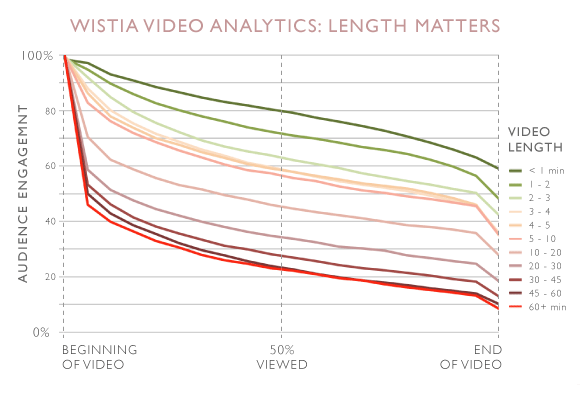
I explained, in response to his first point, that the shorter the video the more likely the viewer would watch the entire thing. If you’ve been reading this blog, you know that one of the key features of a successful video is brevity–typically under three minutes, but around one minute is considered by some to be an ideal length. Some statistics seem to suggest that viewers watch an average 30-second video 85% of the way through, with many of them sticking around until the end, whereas most viewers will watch only 50% of a 2-minute video. In other words, shorter videos are more engaging to the average viewer.

Wistia

One point that occurs to me and that video analytics don’t seem to consider is that these statistics reflect how all viewers react to the video, rather than how the target audience is responding. Many people will click on a video link out of curiosity but find that it is not what they are looking for. Sometimes this decision is made in the first second or two but may also take a bit longer. These people were not your target audience. What would be useful is information about how engaged the target audience is in a video. Video analytics (such as those above) do not distinguish the target from non-target audience (and I’m not sure how easy this would be to do anyway). Someone who is only marginally interested in a topic is much more likely to prefer a shorter video, whereas someone committed to learning something will be willing to invest more time. Statistics seem to suggest that there’s not much difference in viewer engagement between a 4-minute video and a 10-minute video. Viewers who stick around for 4 minutes are likely to watch a longer video through to the end. This insight is important especially for an instructional video. Someone intent on learning a technique will likely be willing to watch the entire video.

In addition, it is sometimes impossible to explain a complex topic in one minute. In that case, you should take the time necessary but put your most important information as close to the beginning as possible, similar to how journalists write news articles. An instructional video also may need to be a bit slower to allow the viewer time to absorb the information, adding to the length. The point is that you should keep your target audience in mind when deciding on length, especially for an instructional video.

Nonetheless, if you can get your instruction across in one minute or less, you should not drag it out any longer than that. Besides the direct effect on viewer engagement due to length, striving to keep the video short encourages you to be more creative and to eliminate extraneous material that just bog things down, which will also have a positive effect on viewer engagement. In fact, I suspect that the latter effect on the quality of the video is often what makes shorter videos more engaging than longer ones. For the scientist videographer, however, this means more work to simplify things sufficiently (without sacrificing accuracy) and to package the information in a more entertaining way.

As to whether a video describing a complex science topic can be done successfully in a minute or less, there are plenty of examples (check out MinutePhysics). But what about a video describing a sampling technique? In the next post, I will critique a 1-minute science video that describes a common sampling method in ecology.